Home / Games
Format ledger
The player with 20 minutes should not sit a 201 pool
A short evening and a fixed chip stack change the format before they change the discard. Points ends on a valid declare. Pool waits for an elimination line. Deals locks the number of hands. Choose the clock first.
Stakeholder
The adult with a fixed stack pays for the wrong clock
A living-room deal can stretch because nobody is eliminated. A cash table does not forgive that stretch. If you have twenty minutes and a stack you already capped, points rummy is the format that can actually end. Pool 201 asks you to survive a line. Deals asks you to pay every hand even when the cards are dead.
House clubs often blur these names. The operator screen is the source. If the seat label says pool and you thought you bought a single hand, you have already lost the first decision.
Comparison
Win condition, leave cost, beginner fit
| Format | Ends when | Joker use | Leave early | Session feel | Beginner fit |
|---|---|---|---|---|---|
| Points | Valid declaration | Wild plus printed joker, house varies | First drop usually cheapest | Short, repeatable | High if drop rules are printed |
| Pool 101 | One player crosses 101 | Same grouping laws | Middle drop still hurts | Medium, elimination | Medium |
| Pool 201 | One player crosses 201 | Same grouping laws | Pride is expensive | Long | Low for a first table |
| Deals | Fixed deal count | Same grouping laws | You still pay the deal | Known stop | High for a closed group |
Figures used here for illustration only. Drop values and deal counts belong on the table screen, not in memory.
Points rummy rewards a clean first drop
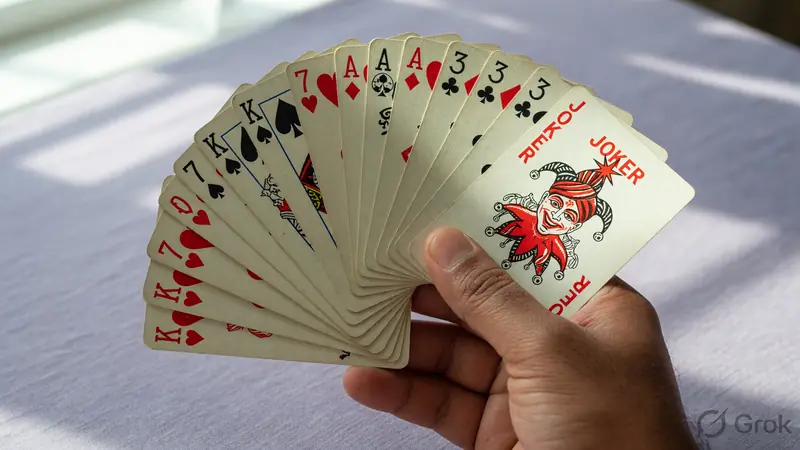
The hand is over when someone shows a legal 13-card grouping. Losers pay the value of ungrouped cards, usually capped. That cap is why a late chase is often worse than a first drop. If the screen hides the cap, treat the format as unread.
Ten-card and gin variants exist in clubs. They are contrast, not clones. Do not assume a Hyperwin seat uses them unless the label says so.
Pool rummy punishes the person who hates leaving
101 and 201 are running totals. A middle drop still adds. The format is honest about attrition and dishonest if you tell yourself you will recover after the line is close. If your stack is already the session cap, pool is the wrong clock.
Deals rummy is a closed-group contract
The number of hands is known. You cannot skip a dead deal without paying. That is useful when four people want a stop time. It is a trap when you wanted a single hand and sat a six-deal table by habit.
Format choice is not a legal clearance
Grouping skill moves expected points inside a lawful social game. It does not move the Promotion and Regulation of Online Gaming Act, 2025. If cash seats are restricted where you sit, a prettier format does not repair that.
Read these five lines on the seat screen
- Format name: points, pool or deals. Refuse a seat that only says rummy.
- Drop values for first and middle drop.
- Invalid declaration penalty.
- Joker rule: printed only, or printed plus wild.
- Stop condition: declare, 101, 201, or deal count.
Format questions
Is 10-card rummy the same as 13-card points?
No. Different hand size, different grouping load. Treat it as another game unless the seat label matches.
Can I switch from pool to points mid-session?
Only if the product offers a new seat. The running pool total does not convert.
Which format is safest for money?
None of them is a safety product. The safer choice is a shorter clock and a pre-set stop, then a legal check.
Does Hyperwin publish a points table?
This desk has not verified an official Hyperwin points table. Read the live seat.
Where do I learn the deal sequence?
Open how to play for one legal 13-card walk. Come back here only to pick the clock.
If the clock fits, continue. If it does not, change the seat.
A wrong format is a decision error, not bad luck. Confirm the seat label, then either play or leave.
Read the seat label after every update
Menus move. A points tile can become a generic play tile after a redesign. That change is a findability fail even if the rules inside stayed the same. Check the five lines again: format name, drop values, invalid-show penalty, joker rule, stop condition.
If you cannot find those five lines, you do not have a format. You have a button. Buttons are not ledgers. Leave and come back through how to play only after the label exists.
A wrong clock is not bad luck
A 20-minute adult in a 201 pool will call the night unlucky. It was a booking error. Points can end on one legal show. Pool can refuse to end. Deals pre-buys the number of wounds. Name the contract before the discard. Club memory is not a seat label. Read the five lines after every update. Gin and 10-card stay contrast, not secret Hyperwin modes. If the label is silent, assume 13-card Indian rummy or leave. Variance talk without a format name is theatre. After the clock is chosen, how to play owns grouping. Strategy owns timing. This route owns the booking.
Choosing a clock with a fixed stack
If you have twenty minutes, points is the format that can actually end. Pool 201 asks you to survive a line. Deals asks you to pay every hand. Booking the second with the first person's calendar is an error, not bad luck.
Read five lines on the seat: format name, first drop, middle drop, invalid-show penalty, stop condition. Refuse a seat that only says rummy. House values move after updates. Check again.
Gin and 10-card are contrast, not secret Hyperwin modes. Different hand size, different grouping load. If the label is silent, assume 13-card Indian rummy or leave.
Variance talk without a format name is theatre. Points is sharp because the hand is short. Pool is social because other people keep you there. Deals is contractual because you pre-bought the wounds.
After the clock, how to play owns grouping. Strategy owns timing. Legal note owns whether the cash seat should exist. This route owns the booking.
A prettier sort does not legalise a restricted cash table. Format choice is not a clearance.
After the booking
You either have a clock or you have a button. Buttons are not formats. Leave buttons. Sit clocks.
Re-read the five lines after updates. House values move. Memory of last Friday's club is not a seat label.
How to play next if grouping is still expensive. Strategy next if grouping is cheap. Legal note if the cash seat is the real question.
A prettier sequence will not fix a 201 booking made with a twenty-minute calendar. That error has a name. Use it.